
Arcade notes · 01
How to Get Better at Claw Machines
Better grabs begin before the claw moves. Read the prize, choose an approach, and treat every result as information—not a verdict on your reflexes.
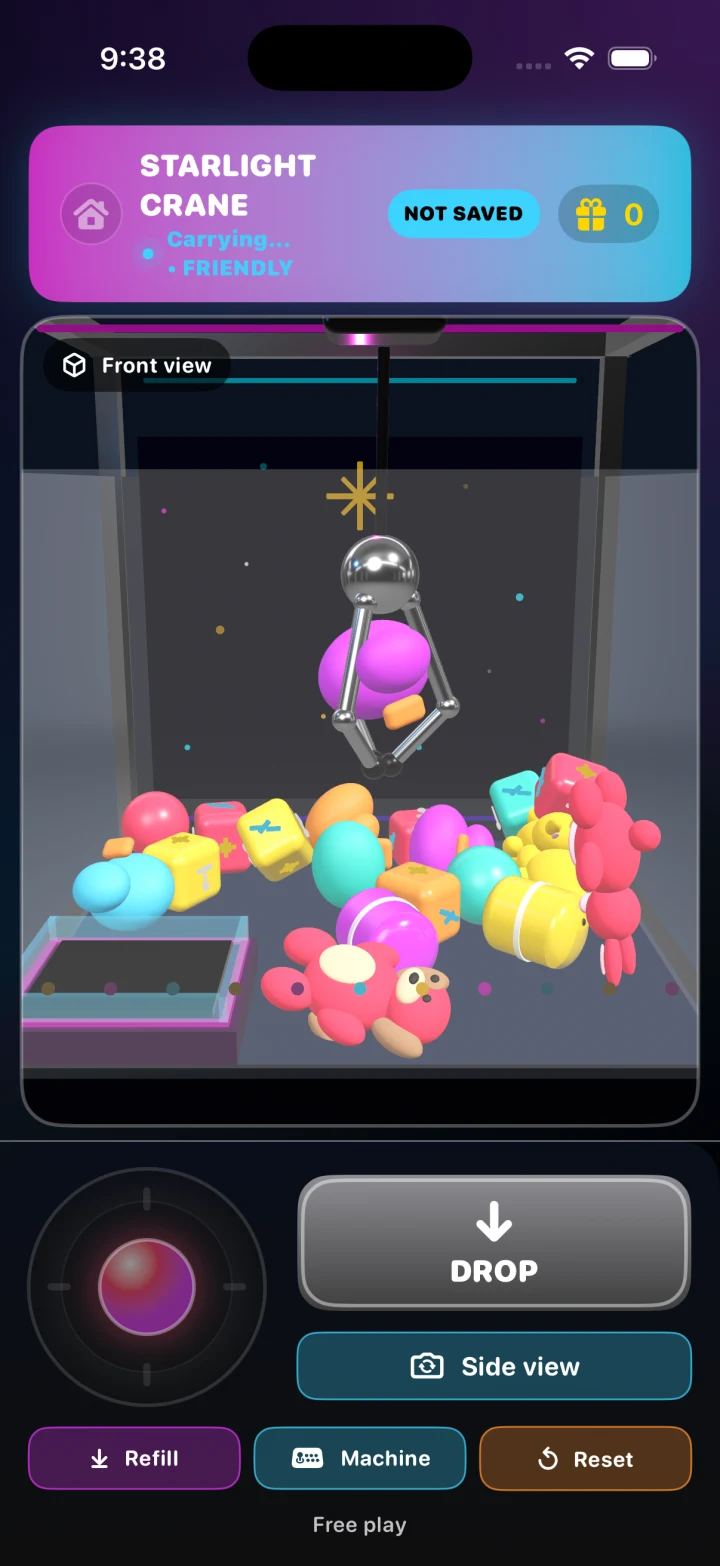
01
A claw machine is a small physics problem with imperfect information. You can improve your decisions, but no single trick makes every machine or prize predictable. The useful goal is to notice more: where the weight sits, how the claw closes, and what must stay balanced on the trip to the chute.
02
Find the center of mass, not just the visual center
The middle of a prize's outline is not always where its weight is concentrated. A plush with a large head, a capsule with an insert, or a figure with a heavy base may tip as soon as it leaves the pile. Before moving the claw, imagine the smallest point that could balance the prize. A grab centered around that point is more likely to lift evenly.
Look for clues: which side sits lower, which end settles first after another play, and whether the prize rolls back to the same position. If you cannot lift the prize cleanly, moving or rotating it into a better orientation can still be progress.
03
Choose an approach that suits the claw
Approach angle matters because claws have geometry of their own. A three-pronged claw needs room for the arms to surround a target. A narrow opening or a prize pressed against glass may stop one arm early, turning a centered-looking attempt into an off-balance pinch.
Check the space around the prize as carefully as the prize itself. Ask where each arm will land when the claw opens, what it might strike on the way down, and whether the arms can close underneath a useful edge. Sometimes approaching a little off-center gives the claw more room to wrap around the actual weight.
04
Watch the carry path
Winning is not only about getting the prize off the floor. The claw must carry it to the chute. A long route magnifies sway, and a dangling corner can catch on nearby prizes. Notice which direction the carriage travels after a grab and whether the prize will hang below, beside, or between the claw arms.
If the machine allows it, favor targets with a clear route. When the path is crowded, a first play that separates the prize may be more sensible than forcing a lift through a knot of neighbors.
05
Use partial grabs as evidence
A near miss tells you how the machine behaves. If the prize rotates during the lift, your grab was probably outside its balance point. If one arm slides away immediately, its landing spot may be too rounded or blocked. If the prize stays level but drops during travel, the path, grip, or machine setting may matter more than your alignment.
Change one thing on the next attempt rather than chasing the prize with a completely different guess. A small adjustment makes it easier to connect cause and effect.
06
Remember that real machines vary
Physical arcade machines differ in claw shape, grip strength, timing, maintenance, prize packing, and operator settings. Some reward precise positioning more consistently than others. Watch a machine before committing multiple plays, set a limit, and walk away when the available targets or machine behavior do not offer a sensible next move.
Starlight Crane is a game, not a promise about every cabinet in the real world. Its Practice mode does offer a pressure-free place to experiment with center of mass, approach angle, crowding, and balance. You can refill the cabinet and try again without changing a Prize Shelf.